SATO Wataru Laboratory
Irony vs. cover-up? Facial dynamics of positive utterances in negative contexts in Japanese speakers
(Namba, Sato, & Eguchi: J Nonverbal Behav)
The present study examined how Japanese speakers express verbal irony through prosody and dynamic facial behavior.
Native Japanese speakers performed short-scripted dialogues that ended with the same positive utterance with positive (sincere) or negative intentional contexts.
The speaker's intent in the negative context was further classified, based on post-recording interviews, as irony or a socially smoothing "cover-up" stance.
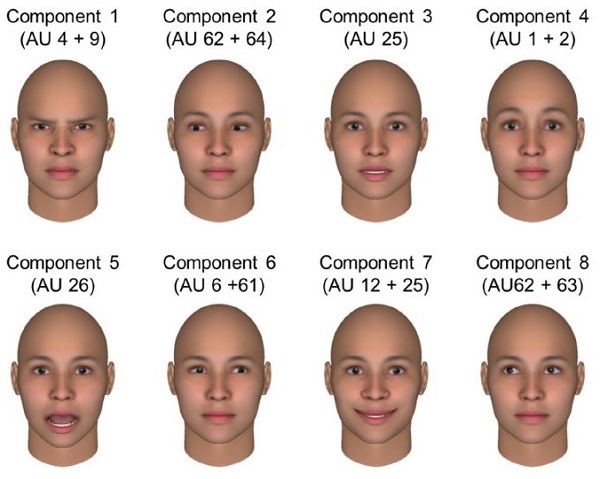
We extracted prosodic features (utterance duration, fundamental frequency, and intensity) and facial features (frame-by-frame facial action units and gaze direction).
Prosodic measures primarily distinguished sincere productions from negative-context stances, with sincere productions showing higher pitch and greater intensity; irony productions were longer than their corre-sponding sincere productions.
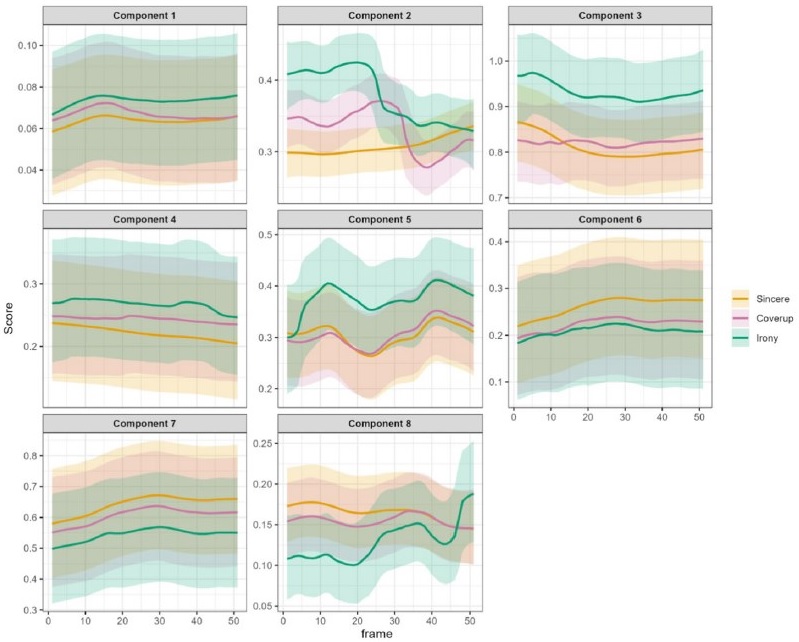
Facial measures revealed clearer differences among the pro-duction groups.
Irony was associated with sustained brow-related activity and enhanced mouth-opening activity, together with an early downward-right gaze tendency.
Sincere utterances showed stronger smile-related activity and a tendency toward upward-right gaze, whereas cover-up had an intermediate and heterogeneous profile.
These findings provide a time-resolved account of multimodal stance marking in Japanese and suggest that posi-tive utterances in negative situations may reflect not only ironic intent but also socially smoothing speaker intentions.
Return to
Recent Research.
Return to
Main Menu.